
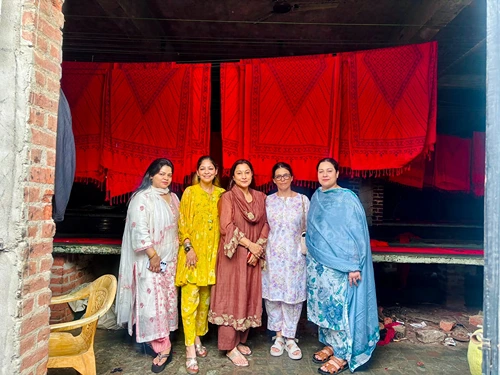
Kannauj is better known, in most conversations, for its attar and perfume heritage. Fewer people associate it with Karchobi — which is precisely why this visit mattered.
On 27th June 2026, a small group of FLO Lucknow members travelled to the Kaaajuj Textiles workshop to see, up close, a craft that rarely gets the visibility it deserves. Karchobi is a form of metallic embroidery — raised, dimensional, and demanding a precision that leaves very little room for error. A single misjudged stitch can alter the texture of an entire panel, which is part of why this craft has remained the domain of artisans trained over years, not weeks.
The visit moved through the complete process, stage by stage. It began with design tracing — the foundational step where a pattern is transferred onto fabric with an accuracy that determines the success of everything that follows. From there, members observed the thread and zari work itself: the metallic threads worked into the fabric with tools and techniques that have changed little over generations, each pass of the needle building texture and dimension rather than simply colour or pattern.
Watching this process unfold in person changed how members understood the craft entirely. What looks, in a finished garment, like decorative embellishment revealed itself to be the product of extraordinary patience — hours upon hours of concentrated, exacting work that no machine has ever successfully replicated at the same quality. The artisans’ hands moved with a fluency that only comes from repetition across years, and members watching found themselves newly aware of how much labour sits quietly inside every Karchobi piece they may have previously worn without a second thought.
This visit reinforced something FLO Lucknow has been building toward through its textile and handicraft engagements across the year — that Uttar Pradesh’s craft traditions are not simply cultural heritage to be preserved in the abstract, but living skill systems sustained by artisans who deserve recognition, fair value, and genuine appreciation for what they do.
Kannauj, through this visit, became a little more visible for exactly that reason.