
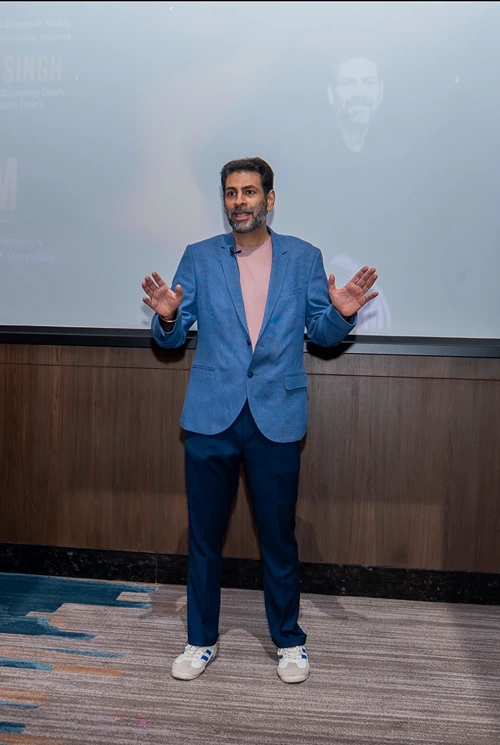
FLO Bangalore hosted an Own The Room session with motivational speaker, actor, filmmaker, and camera-facing coach, Mr Takesh Singh. He dissected the art of storytelling, communicating with authenticity, presence & purpose. With over two decades of professional performance and corporate leadership development experience, his portfolio includes coaching C-suite executives and key personnel at global technology firms such as Google, Amazon, and Ericsson.
He has additionally shaped key industrial presentation narratives for flagship properties including Google for India, Google Marketing Live, Amazon Sambhav, and YouTube Creator Camp. Mr. Singh discussed that the priority was to deconstruct traditional, information-heavy public speaking methods and replace them with interactive, high-connection communication models. Public speaking is fundamentally a two-way human connection dynamic rather than a clinical delivery of a perfected script.
The session opened with a comparative analysis of two university professors. One read flatly from hundreds of static lecture pages, while the other translated complex business law into narratives about everyday individuals. This case study proved that audiences forget raw data but retain how a message made them feel. Participants were urged to reject corporate “masks” and stop pursuing sterile perfection. The core finding was that genuine human connection stems from being real, which ultimately acts as a leader’s most valuable communication asset.
Storytelling was positioned as a practical structural tool for C-suite pitches, team syncs, and investor presentations. The masterclass detailed a four-tier framework:
- Hook: Immediate, undeniable attention grabber.
- Conflict: The core challenge or pain point.
- Resolution: The methodology used to solve the problem.
- Moral/Call to Action: The ultimate takeaway message for the audience.
Storytellers were instructed to paint mental scenes using four fundamental ingredients: establishing the scene visually, engaging multiple physical senses, highlighting sharp contrasts, and injecting genuine emotion. To fight digital distractions like incoming notifications and dwindling attention spans, presenters were advised to skip predictable introductory pleasantries. Instead, they should start immediately with shocking statistics, direct audience questions, or captivating personal stories.
True presence was defined as an active, real-time feedback loop. It requires the speaker to remain fully grounded in the moment, read shifting room dynamics, listen to subtle cues, and dynamically adjust their delivery to match the room’s collective energy. Mr. Takesh Singh talked about four structural mechanics (The Four Ps):
- Presence: Grounding oneself mentally before speaking.
- Practice: Internalizing the core concepts rather than memorizing a rigid script.
- Pause: Leveraging silence to allow key ideas to settle and build natural anticipation.
- Punch: Artificially emphasizing key words to prevent a flat, monotonous delivery.
Also, Kinesic and Body Language Frameworks were shared; practical guidance to optimize physical projection and build trust:
- Maintain an open, relaxed posture.
- Eliminate nervousness, aimless pacing; only move with clear intent.
- Hold deliberate eye contact with individuals for three to five seconds before shifting.
- When presenting digitally, look directly into the camera lens rather than looking at oneself on the screen.
According to Mr. Singh, artificial intelligence tools like ChatGPT can efficiently organize thoughts and draft outlines. Only humans possess the lived experiences, genuine voice, and emotional intelligence that are required to build true empathy and lasting connection.
The masterclass concluded with hands-on exercises. Participants converted everyday occurrences—such as traffic delays, forgotten items, and minor workplace struggles—into structured, compelling narratives, proving that anyone can build great stories from their daily lives.