
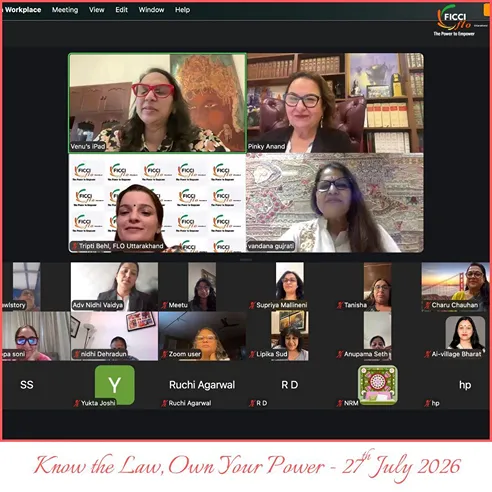
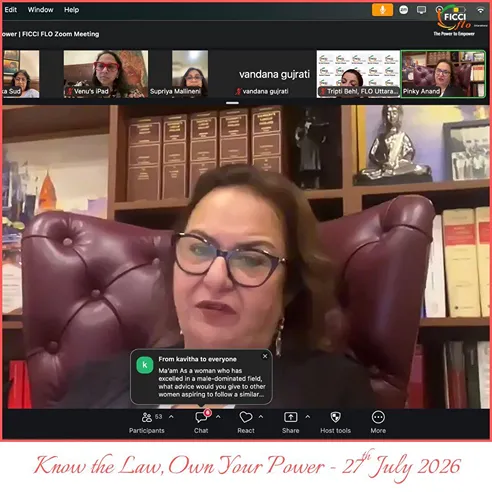
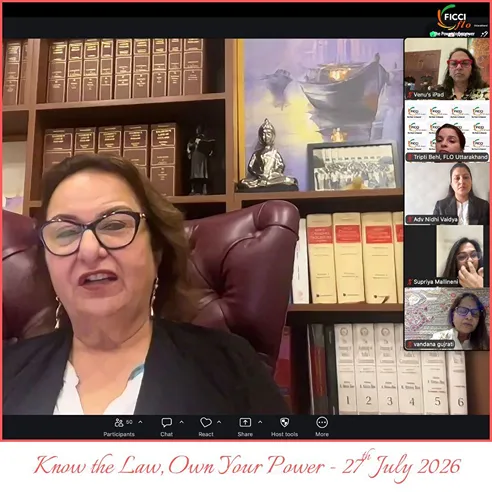
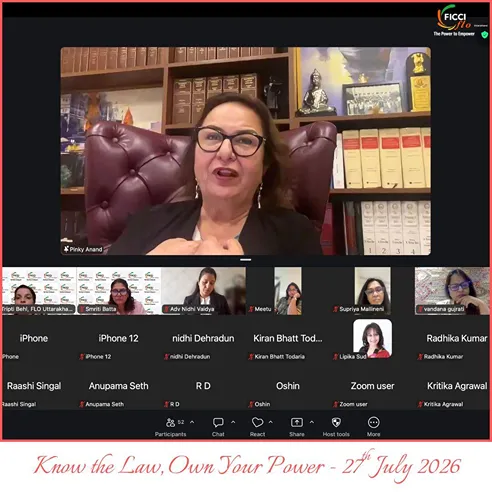
FLO Uttarakhand hosted an insightful webinar, “Know Your Law, Own Your Power: Inheritance Rights of Women,” in collaboration with other chapters, FLO Vijayawada and FLO Indore. This virtual legal awareness session was organized under the aegis of the Legal Advocacy vertical led by Venu Dhingra. The keynote speaker was Dr. Pinky Anand, Senior Advocate at the Supreme Court of India and former Additional Solicitor General.
The session was focused on building foundational legal and financial literacy, with special emphasis on Sections 6 and 15 of the Hindu Succession Act and Muslim Personal Law to explain equal property rights for daughters and asset devolution. Dr. Anand strongly advised women to track their personal assets and property tax matters to protect their long-term autonomy.
Key Objectives
- Demystify Inheritance Frameworks: Educate women on the complexities of Sections 6 and 15 of the Hindu Succession Act and Muslim Personal Law to ensure they understand their equal rights as coparceners and heirs.
- Foster Financial Independence: Encourage women to actively track their personal assets, understand property taxation, and manage documentation to protect their long-term economic security.
- Bridge the Awareness Gap: Connect legal experts directly with grassroots communities, corporate members, and academic institutions—including law faculty and students from Uttaranchal University, Dev Bhoomi Uttarakhand University, and Graphic Era University—to cultivate a culture of legal awareness.
- Resolve Real-World Queries: Provide a direct, open-forum Q&A platform to solve immediate, practical confusion surrounding property disputes, asset devolution, and the execution of wills.
Key Takeaways
- Women should know about their rights: importance of legal awareness as a cornerstone of women’s empowerment. She urged women to understand their legal rights, remain informed about their property, financial assets and taxation matters, and confidently exercise their rightful claims without allowing emotions to influence important legal and financial decisions.
- Women should be aware of their property, taxation, and assets themselves: provisions of the Hindu Succession Act, particularly Section 6, which recognises daughters as equal coparceners, and Section 15, which governs the succession of a woman’s property. She also discussed the provisions under Muslim Personal Law, emphasising that a daughter is mandatorily entitled to a share in family property.
- Women should not be emotional while exercising their rights: notable examples and landmark cases, including those involving the Lalit Hotel Group, the Jindal Group, and the Sunjay Kapur inheritance dispute, demonstrated how inheritance laws are interpreted and applied in real-life situations.
Impact & Outcome
The session was attended by 58 chapter members alongside law students and faculty from Uttaranchal University, Dev Bhoomi Uttarakhand University, and Graphic Era University. The event concluded with an interactive Q&A session addressing real-world property documentation and disputes.