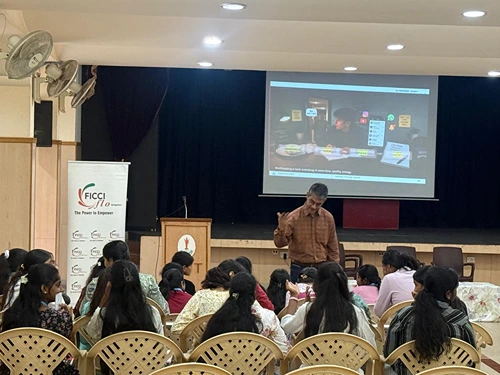
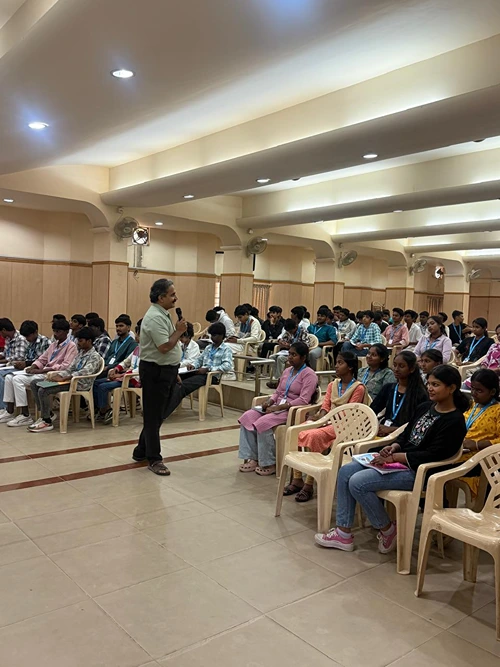
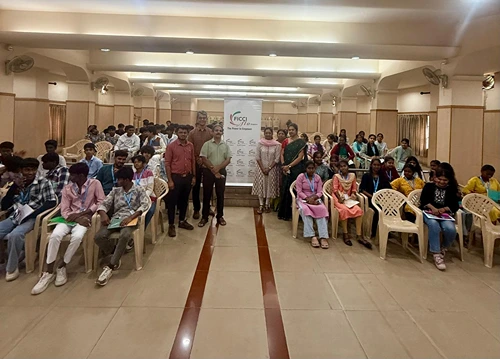
FLO Bengaluru, under the leadership of Chairperson Deepa Boopesh Reddy, hosted the second workshop in the 5C’s Human-Centric Skills series in collaboration with Coacharya Foundation on 20th August 2026. The workshop was designed to equip students with practical skills that enable them to navigate a rapidly changing world with greater self-awareness, discipline, and discernment.
Facilitated by Narendra Yelandur Ranganath and Sorabh Sharma, the session focused on two key areas: Self-Management and Critical Thinking. Participants were introduced to practical tools and techniques for managing their priorities, time, attention, focus, and energy. The self-management segment explored the Eisenhower Matrix for prioritising tasks, a Time Audit to understand how time is spent, and Deep Work principles to strengthen concentration and productivity.
Mindfulness practices were introduced as a way of managing energy and maintaining greater awareness and balance. The critical-thinking component encouraged students to question, verify, and evaluate information before accepting or sharing it. Frameworks such as the THINK framework and 5 Whys provided structured approaches to assessing the authenticity, correctness, relevance, and usefulness of information—an increasingly important skill in the digital age.
The workshop also introduced a reflective exercise around “Who do you want to become?” Students were encouraged to examine their role models, identify the qualities they admire, and use these observations as a mirror to understand their own aspirations, values, and desired identity.
Key Takeaways
- Prioritisation is a skill: Use tools like the Eisenhower Matrix to distinguish between what is urgent and what is important.
- Audit your time: Understanding where time is actually spent helps identify distractions and improve productivity.
- Protect your attention: Deep Work principles can help students develop stronger focus in an increasingly distracted environment.
- Manage energy, not just time: Mindfulness and self-awareness help individuals recognise and manage their physical and mental energy.
- Think before you consume: Critical thinking is essential for evaluating the information we encounter every day.
- Verify before sharing: Students were encouraged to check the authenticity, accuracy, and relevance of information before accepting or forwarding it.
- Use structured thinking: Frameworks such as THINK and 5 Whys provide practical methods for questioning assumptions and finding deeper causes.
- Ask better questions: Curiosity and thoughtful questioning are important foundations of critical thinking.
- Choose role models consciously: Looking at people we admire can help identify the qualities and values we want to develop ourselves.
- Define who you want to become: Self-management and critical thinking ultimately help students make intentional choices about their future identity, behaviour, and goals.
Impact & Outcome
With 160 FLO members participating, the session strengthened the broader objective of developing confident, thoughtful, adaptable, and responsible young individuals. By combining practical productivity tools with critical-thinking frameworks and self-reflection, the workshop moved beyond conventional classroom learning and focused on building capabilities that can support students throughout their personal, academic, and professional journeys.