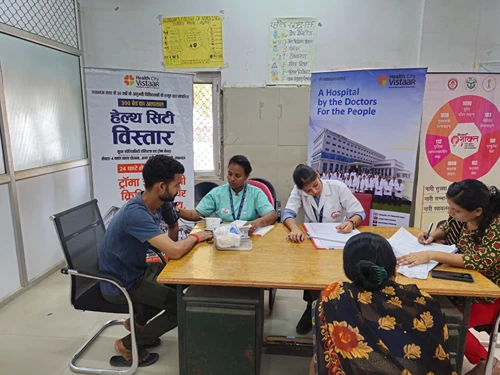
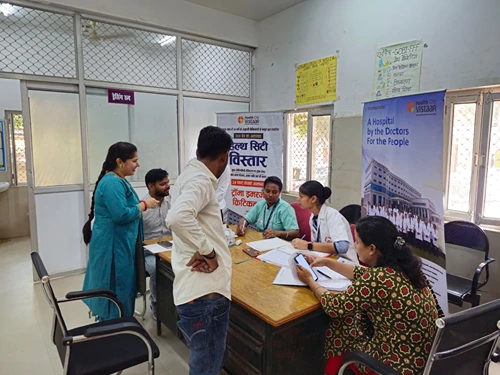
FLO Lucknow organized a Free Eye Checkup Camp in collaboration with Diya Baati Foundation. The One Stop Centre in Chinhat is, on most days, a place people visit for a specific, defined purpose. On 26th June 2026, it became something more — a site where more than 100 people received an eye examination they might otherwise have gone years without.
The FLO chapter partnered with Diya Baati Foundation to bring this camp to life, and the collaboration reflected a shared understanding of what community healthcare actually requires: not just goodwill, but logistics, medical expertise, and a location people can actually reach without disrupting their day. Chinhat and the community served by the One Stop Centre are exactly the kind of area where a free, accessible camp of this nature makes a tangible, immediate difference.
Dr. Pooja Kanodia led the examinations with clinical precision, working through more than 100 individuals over the course of the day. For many, this was the first time an eye specialist had properly assessed their vision — and the findings, as is often the case in underserved communities, revealed problems that had simply never been named before. Mrs. Poonam Tiwari’s presence added a layer of warmth to the day, ensuring that the experience felt supportive rather than clinical, particularly for those encountering this kind of examination for the first time.
The camp’s structure was designed for genuine accessibility — no appointment systems to navigate, no consultation fees to weigh against household budgets, no distance to travel beyond the community’s own centre. People walked in, were examined, and walked out with actual information about their eye health, often for the first time in their adult lives.
FLO Lucknow’s belief that “Better Vision, Better Life” is more than a slogan around which this camp was built found real expression across the day. A parent who can now see clearly enough to help a child with homework. A worker whose eye strain has a name and, potentially, a solution. These are not dramatic outcomes, but they are exactly the kind of
quiet, foundational change that community healthcare interventions are meant to create — one examination, one person, at a time.