


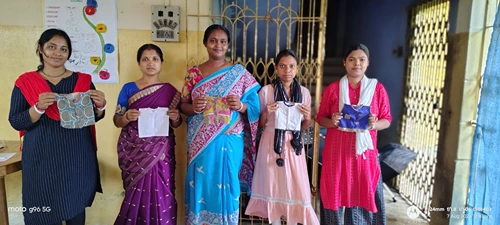
FLO Kolkata, under the leadership of Chairperson Ms. Mansi Agarwal, conducted a two-day Baby Set Making Workshop at Apni Kutir, Diamond Harbour, from 5–6 July 2026, engaging 49 participants in an immersive, hands-on learning experience under the Life Skills initiative.
The workshop was designed to build upon participants’ existing sewing abilities and take them towards a more comprehensive understanding of product creation and livelihood application.
Instead of limiting the intervention to stitching techniques, participants were encouraged to independently develop baby sets as finished products, allowing them to experience the complete process of converting vocational knowledge into something functional, presentable and potentially marketable. Throughout the workshop, participants actively worked on the preparation of baby sets, applying their existing sewing knowledge while strengthening their confidence, precision and garment-making abilities.
The practical format enabled learners to identify how their technical skills could be adapted to create products with clear everyday utility. A significant dimension of the workshop was its focus on quality and hygiene. Participants were sensitised to the importance of maintaining hygienic practices while preparing baby-related products, thereby encouraging greater awareness of product suitability and customer expectations. This introduced an important quality-conscious approach to their existing vocational skills.
The training also extended into product presentation, packaging and selling. Participants were guided on how a baby set could be appropriately packaged and presented as a gift item, broadening its potential appeal beyond direct household use. This helped learners understand that market readiness involves more than making a technically sound product; it also encompasses cleanliness, finishing, presentation, packaging and the ability to position the product for prospective customers.
From a livelihood perspective, this was a critical progression. Participants were encouraged to recognise that their sewing capabilities could potentially support home-based production, customised orders, gifting requirements and small-scale sales. The workshop therefore helped shift the perception of sewing from a basic vocational skill towards a more commercially relevant product-development capability.
The experience also strengthened participants’ creative confidence and practical decision-making. As they developed their own baby sets, they had an opportunity to apply their knowledge independently and understand the importance of consistency, finish, and presentation in creating products that others may be willing to purchase. The workshop consequently established a more complete skill-to-market framework: participants developed the product, considered hygiene and quality, learnt about presentation and packaging, and were introduced to the fundamentals of selling. This integrated approach enhanced the practical economic value of the training and gave participants a stronger foundation from which to explore future livelihood opportunities through sewing and small-scale garment production.