
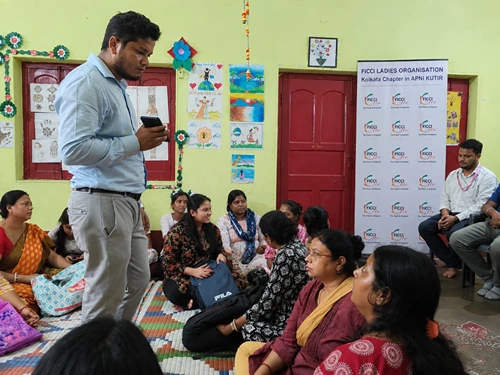
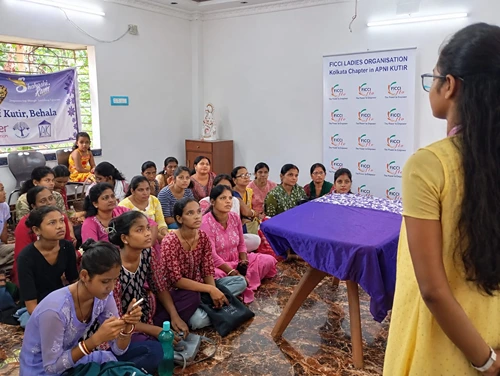
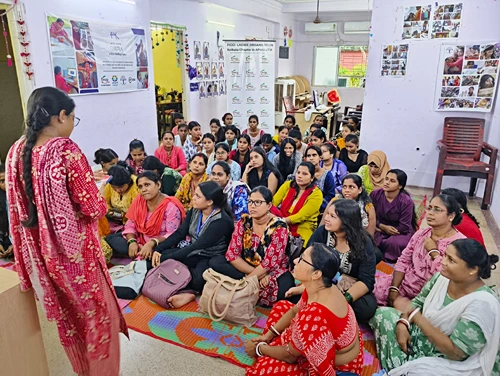
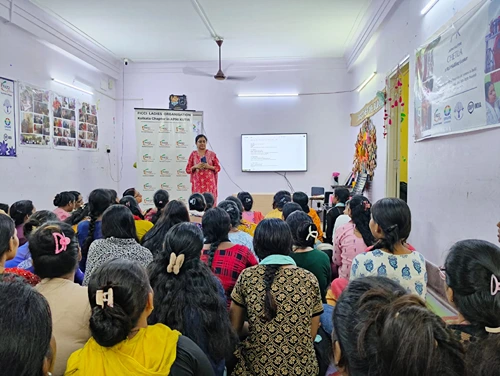
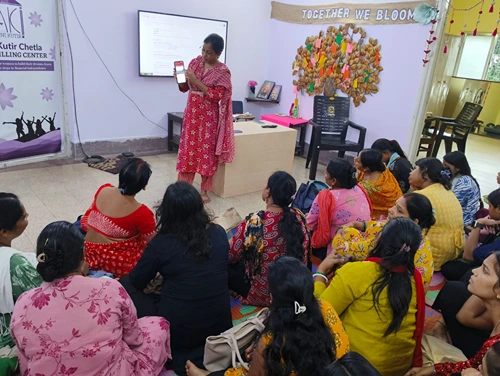
FLO Kolkata, under the leadership of Chairperson Ms. Mansi Agarwal, conducted a series of Smartphone Adoption and Digital Learning sessions to strengthen the digital capabilities of community women and enable them to engage more confidently with technology in their everyday, professional, and economic lives. The intervention brought together two complementary but distinct dimensions of digital empowerment: smartphone literacy for practical independence and safety, and digital learning for foundational computer and workplace readiness.
The Smartphone Adoption session at AK Chetla, facilitated by Riziya Sultana (CT), focused on making smartphone technology more accessible, intuitive, and purposeful for participants. Through demonstrations, practical explanations, and interactive engagement, participants were introduced to essential smartphone functions and encouraged to overcome hesitation around using digital devices independently. The learning carried a strong livelihood and personal-safety dimension.
Participants can use smartphones to photograph and showcase their products, communicate with prospective customers, respond to enquiries, coordinate orders and promote small or home-based businesses through digital platforms. Such capabilities can help grassroots entrepreneurs extend their visibility beyond immediate neighbourhood networks and develop more direct customer communication.
Smartphones also have practical relevance to personal security and connected mobility. Participants were made aware of the utility of sharing their live location with trusted family members or contacts when travelling, returning home after work, visiting unfamiliar locations or undertaking business-related travel. WhatsApp’s official guidance confirms that Live Location enables users to share their real-time location for a selected period and discontinue sharing at any time.
Thus, smartphone adoption was positioned not simply as device familiarity, but as a means of strengthening digital independence, commercial communication, market visibility and everyday safety awareness. The Digital Literacy sessions, conducted across Banshberia, Kharda and Topsia, addressed a broader layer of digital capability. Participants were introduced to foundational computer skills including computer operation, document creation, internet browsing and email communication, alongside awareness of online safety and cybersecurity.
This component was significant in developing functional digital readiness. Participants gained exposure to basic tools required to navigate an increasingly technology-enabled educational and professional environment. The ability to create documents, browse the internet, and communicate through email provides a foundation for accessing information, undertaking routine digital tasks, and engaging with future learning or employment opportunities.
The sessions also strengthened awareness of responsible digital participation. Introducing participants to cybersecurity and online safety helped them recognise the importance of protecting personal information and exercising greater caution while navigating digital spaces.
The distinction between the two learning streams therefore created a more comprehensive intervention: smartphone literacy strengthened everyday digital independence and practical safety, while computer-based digital learning developed foundational capabilities for education, work and continued digital advancement.
Together, the sessions reached 51 participants through Smartphone Adoption and 89 through Digital Literacy, creating a combined direct reach of 140 participants. The broader impact lies in enabling community women to move from limited or assisted technology use towards confident, purposeful, and increasingly independent digital participation, with technology becoming an instrument for livelihood enhancement, safer mobility, communication, market access, learning, and economic opportunity.