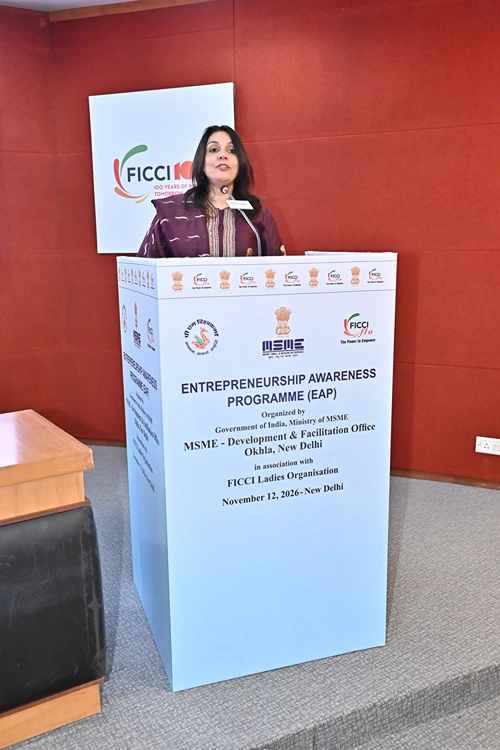
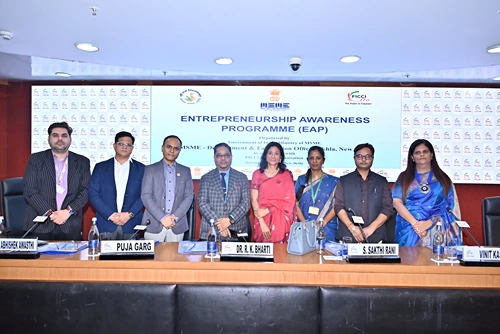
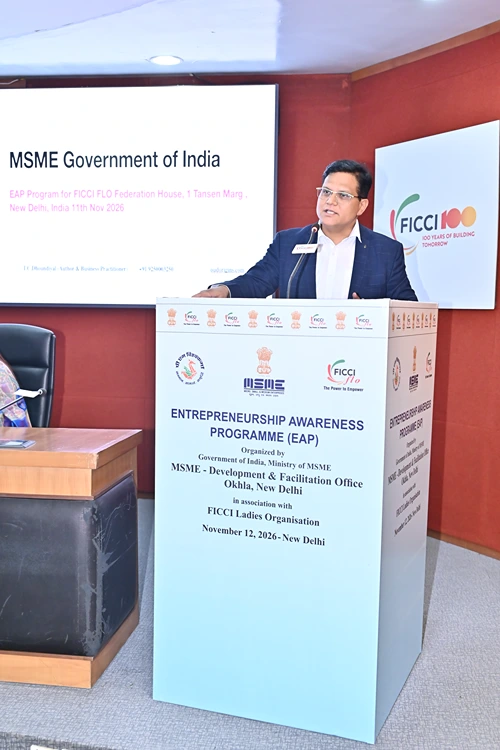
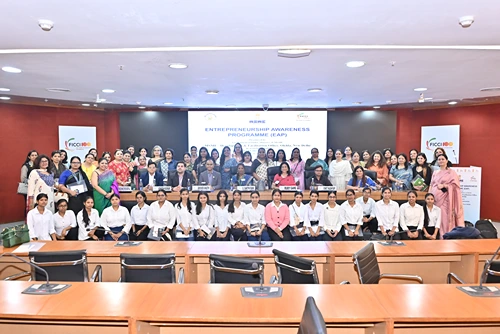
FICCI FLO, under the leadership of its 43rd National President, Ms. Puja Garg, organised an insightful Entrepreneurship Awareness Programme (EAP) in collaboration with the MSME Development and Facilitation Office (MSME-DFO), New Delhi, under the Ministry of Micro, Small and Medium Enterprises, Government of India. The programme aimed to empower aspiring and existing women entrepreneurs with knowledge of government schemes, financial assistance, banking facilities, and institutional support available to MSMEs.
The event facilitated on-the-spot Udyam Registration and a GST and Taxation Help Desk. Also, MSME information booklets were distributed to offer practical guidance and help participants access relevant resources. In her welcome address, Ms. Puja Garg highlighted the significant contribution of MSMEs towards employment generation, manufacturing, exports and regional economic development. Ms. Garg emphasised making opportunities, mentorship, institutional support and essential resources accessible for women entrepreneurs to encourage their participation in India’s entrepreneurial ecosystem.
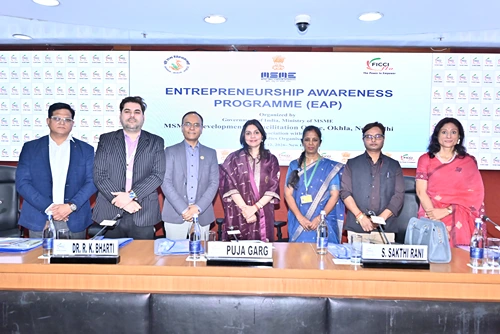
The panel discussion brought together experts from MSME-DFO, State Bank of India, National Small Industries Corporation (NSIC) and the private sector:
- Dr. R.K. Bharti, Director, MSME-DFO
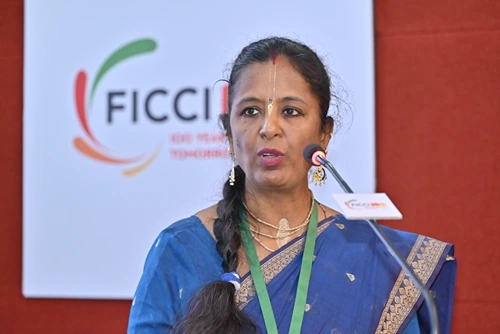
- Smt. S. Sakhti Rani, Gr.-I (IEDS), Assistant Director, MSME-DFO
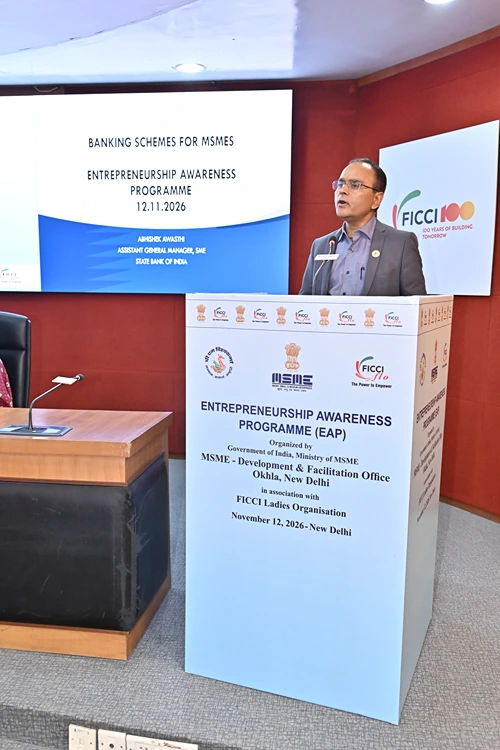
- Mr. Abhishek Awasthi, Assistant General Manager, SMEBU, State Bank of India, New Delhi
- Mr. Ashish Arora, Manager, NSIC, Okhla
- Mr. Vinit Kashyap, Deputy General Manager, NSIC, Okhla
- Mr. Tarachand Dondiyal, Director, Milestone Achievers Pvt. Ltd.
These panellists shared valuable insights into government support mechanisms, financial assistance, subsidies, reimbursement facilities, public procurement, market linkages, quality certifications and institutional funding for MSMEs. Their discussion highlighted the importance of financial literacy, gender parity, business sustainability and leveraging government-backed platforms to improve the competitiveness and scalability of MSME enterprises in India.
The session is part of FICCI FLO’s National MSME Initiative, led by Ms. Ruby Garg (Initiative Lead) and Ms. Jyoti Jain (Initiative Co-Lead), who played an instrumental role in steering the session, facilitating its coordination and ensuring meaningful engagement between the panelists, entrepreneurs, and the FLO members.
Key Takeaways
- Women Entrepreneurship and Nation Building
Dr. R.K. Bharti appreciated women entrepreneurship and leadership efforts which have contributed to nation-building and economic development in India. Also, he encouraged aspiring entrepreneurs, particularly the youth, to identify emerging opportunities and build sustainable businesses by taking timely and informed decisions.
- Government Support and MSME Development
Smt. S. Sakhti Rani highlighted the Ministry of MSME’s role in employment generation and promoting women’s entrepreneurship. Referring to the estimated 11.10 crore jobs generated by the Indian MSME sector, she discussed government schemes, Entrepreneurship Development Programmes (EDPs) and cluster development initiatives for supporting local businesses.
Smt. Rani urged present FLO members to complete Udyam Registration for their small businesses to be officially registered with the Ministry of MSME, Government of India. A registered MSME gets access to various government schemes, institutional support, and other benefits.
- Revised MSME Classification
The revised MSME classification criteria, effective from 1 April 2025, were explained based on investment in plant and machinery/equipment and annual turnover:
- Micro: Investment up to ₹2.5 crore and turnover up to ₹10 crore.
- Small: Investment up to ₹25 crore and turnover up to ₹100 crore.
- Medium: Investment up to ₹125 crore and turnover up to ₹500 crore.
- Digital Platforms and Grievance Redressal
The MSME Samadhaan portal was highlighted as a mechanism for Micro and Small Enterprises to raise complaints regarding delayed payments from buyers. On the other hand, the CHAMPIONS portal provides grievance redressal, guidance, handholding, and support across finance, marketing, technology, and capacity building.
- Government Schemes for Entrepreneurs
Key initiatives by the Government of India, including Pradhan Mantri MUDRA Yojana (PMMY), Prime Minister’s Employment Generation Programme (PMEGP), Stand-Up India, Credit Guarantee Fund Trust for Micro and Small Enterprises (CGTMSE), and incubation programmes, were discussed for facilitating business establishment, credit access, entrepreneurship development, and enterprise expansion for MSMEs.
Government initiatives such as the Startup India Action Plan, Fund of Funds for Startups, Startup India Seed Fund Scheme, Credit Guarantee Scheme for Startups, and Atal Innovation Mission were highlighted for supporting innovation, early-stage funding, capital requirements, and startup development.
- MSME-DFO Support and Reimbursement Facilities
Various support initiatives were discussed, including packaging assistance, reimbursement of eligible trade fair participation and barcode registration expenses, Micro and Small Enterprises Cluster Development Programme (MSE-CDP), ZED (Zero Defect Zero Effect) Certification and applicable government subsidies to improve product quality, market readiness and business competitiveness.
- Banking and Financial Literacy
Mr. Abhishek Awasthi delivered an informative presentation on banking and financial support available to entrepreneurs for making their unique business ideas into a possibility. He emphasised the importance of understanding government based financial schemes, eligibility requirements and credit options to access institutional funding effectively.
- Credit Facilities and Women Entrepreneurship
According to Mr. Awasthi, entrepreneurs should take the benefit of fund-based credit facilities, such as demand loans, term loans, cash credit, working capital loans and overdrafts. Financial initiatives such as PMMY, CGTMSE, SBI Asmita and MSME Udaan were highlighted for facilitating access to business finance, credit guarantees and growth capital, including targeted support for women entrepreneurs.
- NSIC Schemes and Institutional Support
Mr. Ashish Arora and Mr. Vinit Kashyap highlighted NSIC’s flagship schemes and support services, including incubation facilities, machinery assistance, the Single Point Registration Scheme (SPRS), raw material assistance, equity funding, the Self-Reliant India (SRI) Fund and venture capital opportunities to promote MSME development, innovation and business expansion.
- Marketing Strategies and Business Leadership
Mr. Tarachand Dondiyal shared practical marketing strategies and leadership frameworks to help entrepreneurs grow their businesses with limited budgets and resources. He elaborated on zero-cost marketing techniques, lead-to-revenue strategies, and emotional marketing, highlighting cost-effective approaches to customer engagement, business development, and sustainable growth.
Impact and Outcome
More than 100 attendees benefited from the Entrepreneurship Awareness Programme (EAP) as it enhanced participants’ awareness of government schemes, subsidies, financial assistance and institutional support available to MSMEs. The on-the-spot Udyam Registration facility and GST and Taxation Help Desk further supported entrepreneurs in understanding business formalisation and regulatory requirements.
The event also strengthened engagement between entrepreneurs, government institutions, financial organisations and industry experts, creating greater awareness of the resources and support available for establishing and scaling women-led enterprises. EAP session encouraged attendees to consider entrepreneurship, self-employment and to identify viable business opportunities.