
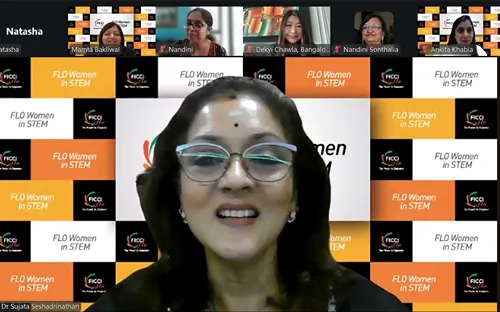
FICCI FLO, under the leadership of National President, Ms. Poonam Sharma, hosted an inspiring virtual session, “Mission I’M Possible- Nandini Way” under its Women in STEM and Tech initiative. This session is a part of an initiative that focuses on increasing the interest of young girls to pursue careers in Science, Technology, Engineering, and Mathematics (STEM) fields.
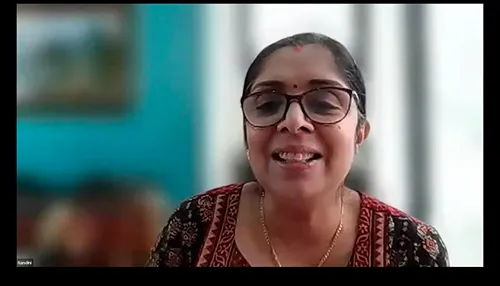
This online session featured Ms. Nandini Harinath, a distinguished scientist at ISRO. She has played important roles as Deputy Operations Director for the Mars Orbiter Mission- Mangalyaan and as Project Manager and Mission Designer for Chandrayaan-3. Ms. Nandini talked about India’s achievements in space and how she tackled different challenges while managing different spacecraft missions.
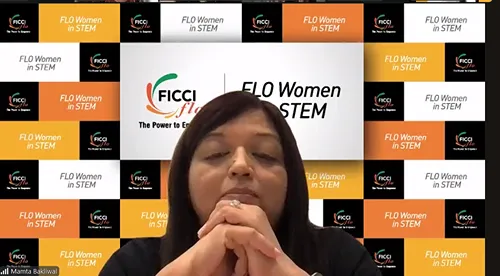
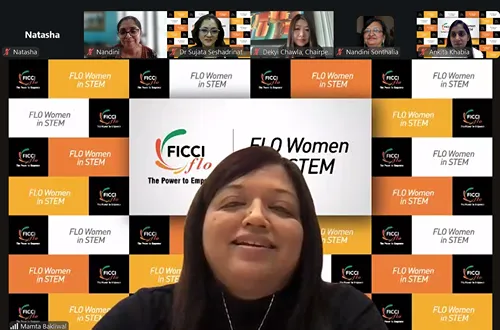
Ms. Mamta Bakliwal, National Head- Women in STEM and Tech initiative, served as the day chair to provide the best experience to the attendees. Also, Ms. Rutvi Vyas, co-chair, and other team members, Dr. Sujatha Sheshashidrinathan, Anupama Modi, Ankita Khabia, Meghana Singhania, and Pinky Rajpal played crucial roles in making this virtual session possible.
Key Highlights
- Day chair, Ms. Mamta Bakliwal, discussed the success of the Women in STEM and Tech initiative during her welcome address. She revealed that this initiative has reached 30,000 girls and women. Also, various workshops are conducted, and a whitepaper on the STEM gender gap was launched under this initiative.
- Ms. Nandini Harinath inspired the attendees by talking about her space missions and achievements. As an ISRO scientist, she has made huge contributions by managing low-Earth orbit satellites and interplanetary missions.
- She continued the discussion by talking about different challenges for women in the space industry, such as resource management for future missions, and the lack of women leaders.
- There are still various opportunities available for students and women professionals from various fields, such as engineering, computer science, and law, who are interested in working in the space industry.
- Ms. Nandini added that the number of space startups is increasing day by day. There are good opportunities available in satellite development.
- According to Ms Nandini, women have overcome stereotypes by becoming reliable in handling critical space missions in recent years.
Key Learnings
- Space missions involve long preparation periods and routine work similar to other professions.
- Persistence and seeking support during challenging times can help women in the space industry to tackle different challenges despite the unpredictability of space missions.
- India’s space programs are cost-effective than their Western counterparts. An ISRO-led mission is successful due to indigenous technology development and innovative engineering techniques, such as multiple burns around Earth to build enough energy to reach Mars.
- India is now capable of reaching Martian orbit and conducting scientific research, all while operating on a limited budget. Also, research on using local resources on Mars is in its early stages. ISRO has touched on the possibility of life on other planets. Also, India’s vision for 2047 includes a manned mission to the moon.
- Artificial Intelligence and simulation technology are used in lunar landing and rover operations handled by ISRO, such as the autonomous landing of the Vochandrayaan-3 spacecraft. This landing relied on sensors, cameras, and onboard computers to make decisions. Also, AI technology is used for satellite health monitoring and anomaly detection, as well as its potential for predicting failures.
- There are various societal applications of satellite technology, including its use in railways, navigation, communication, and disaster management. Satellites can improve daily life through methods like crop management, earthquake prediction, and environmental monitoring.
Impact And Outcome
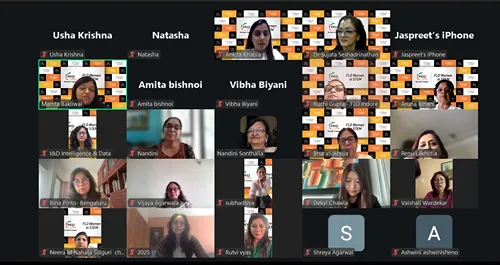
Around 188 attendees benefited from this inspirational virtual session centered on women’s participation in the space industry and available opportunities. The session aimed to encourage younger generations to pursue careers in STEM fields. Also, it focused on overcoming gender disparities in technical fields.